
Some days in business are not dramatic at all. They are simply full. Messages arrive faster than they can be answered, small decisions pile into large ones, and the calendar feels like a living creature that keeps growing while you look away. It was one of those days when I called Bobby Win. Nothing was “wrong,” nothing was urgent in the emergency sense; it was business as usual at a company that runs hard, serves serious anglers, and tries to keep the standard high even when the tempo is unforgiving.
Yet I was genuinely looking forward to that conversation, because the work we are beginning here is not a marketing exercise. It is a long-term commitment to write about shark fishing with enough depth, care, and honesty that a serious reader can trust it, return to it, and share it without embarrassment.
Bobby answered the way you would expect a calm, capable fisherman to answer: present, focused, and friendly.
He has the quiet steadiness of someone who has seen the ocean in more moods than most people will ever notice, and who understands that the best stories are usually built on preparation rather than surprise.
I asked if I could record the call.
Not for drama, not to archive a performance, but because accuracy matters. Shark fishing is not a place where fuzzy memory should be allowed to become doctrine. If we were going to build a dedicated shark series on Catch The Fever’s platform, then the foundation had to be clean: real experience, plainly described, with enough detail to be useful and enough humility to keep us honest.
That recording is now one of our reference points, and this preface is the first public signal of where we are going.
By reading this, you are reading the opening page of a much larger series. Think of it as a doorway rather than a destination. Over the coming months, I will write for the shark anglers who already live inside this world, for surf fishermen who are curious but cautious, for freshwater anglers who feel that familiar itch for the next challenge, and for anyone who respects both the tradition of big-game fishing and the evolving responsibility that modern fisheries, modern beaches, and modern public attention demand.
Here is what you can expect it will NOT be: this series will not be built on myths. It will not be assembled from recycled internet templates. It will be written in CTF’s voice and our collective temperament—citizens of the world in how we enjoy ideas and meaning, American in how we value clarity and usefulness—while being grounded in sources that can be verified: government agencies, established fisheries guidance, peer-reviewed research where it is relevant, and the lived knowledge of reputable anglers who have earned their perspective the hard way.
Bobby will be one of those anchors.
He isn’t a guest flying by. He is part of the internal fabric of Catch The Fever, and he is also part of the external reality of land-based shark fishing: a man with years of experience on the beach, a deep respect for safety, and a clear instinct for what separates a legitimate sport from reckless behavior that brings regulation down on everyone.
When you listen to him, you can feel that he is not interested in fantasy. He is interested in outcomes.
I am, too.
Why this belongs at Catch The Fever?
Catch The Fever grew into what it is because our customers are not casual about fish. They care about performance and reliability because they have been humbled by fish that refuse to play along. They care about gear that holds up because they fish hard, they fish often, and they do not want their equipment to become the weak link when something heavy decides to test them.
Shark fishing sits naturally near that spirit.
It is not the same as trophy catfishing, and it should not be treated as a simple extension of it, but it shares a familiar core: the hunger for a serious fight, the respect for strong animals, and the knowledge that the line between confidence and arrogance is thin.
At the same time, shark fishing carries a different burden. You are often fishing in public spaces where non-anglers are present. You are interacting with animals that trigger real fear in the general population. You are operating inside a regulatory environment that changes, tightens, and evolves, sometimes quickly, when agencies respond to incidents or public pressure. And you are doing all of this under the gaze of modern attention, where one irresponsible moment can become a viral problem that harms the sport for everyone.
So yes, we are building this because there is a real information hungry audience of anglers and also because shark fishing deserves writing that respects its complexity. If we do this correctly, it will we will be part of supporting an initiative that is bigger than us which contributes to sharing the passion around fishing while improving the conversation around shark fishing by making responsibility feel normal rather than restrictive.
That is the aim.
Bobby’s ladder, and why it resonates
When I asked Bobby how he got into shark fishing, he described something that is almost universal in angling, yet rarely articulated well: a ladder of challenge.
He started the way many of us start, with small fish in freshwater. Then bass, then catfish. Each step introduces a new kind of fight, a new requirement of patience, and a new appreciation for what size and strength actually mean in water.
Anyone who has stood in the dark beside a river, feeling a heavy catfish move like a stubborn engine on the other end of a line, understands that there are fish that educate you.
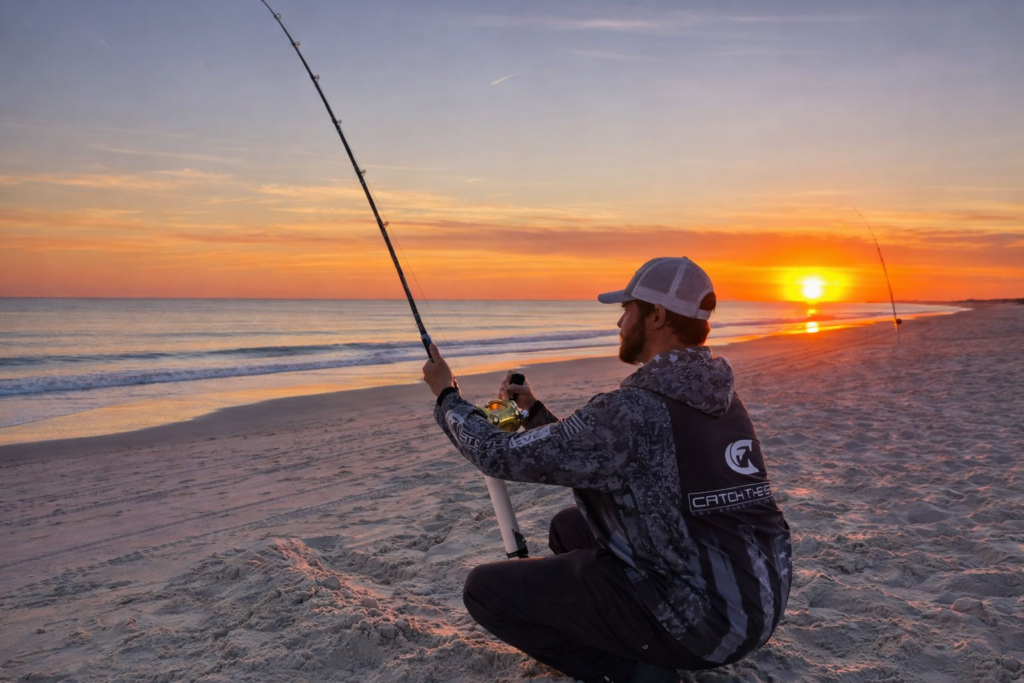
Then Bobby moved to Wilmington, North Carolina, and the ladder shifted environments. The surf became his classroom. He fished the smaller predators that are abundant and fun—mackerel, bluefish—and enjoyed it. But his mind kept returning to the question that defines a certain type of angler: what is the hardest fighting fish in this body of water, and what would it take to meet it on fair terms?
In the salt, that question often points to sharks.
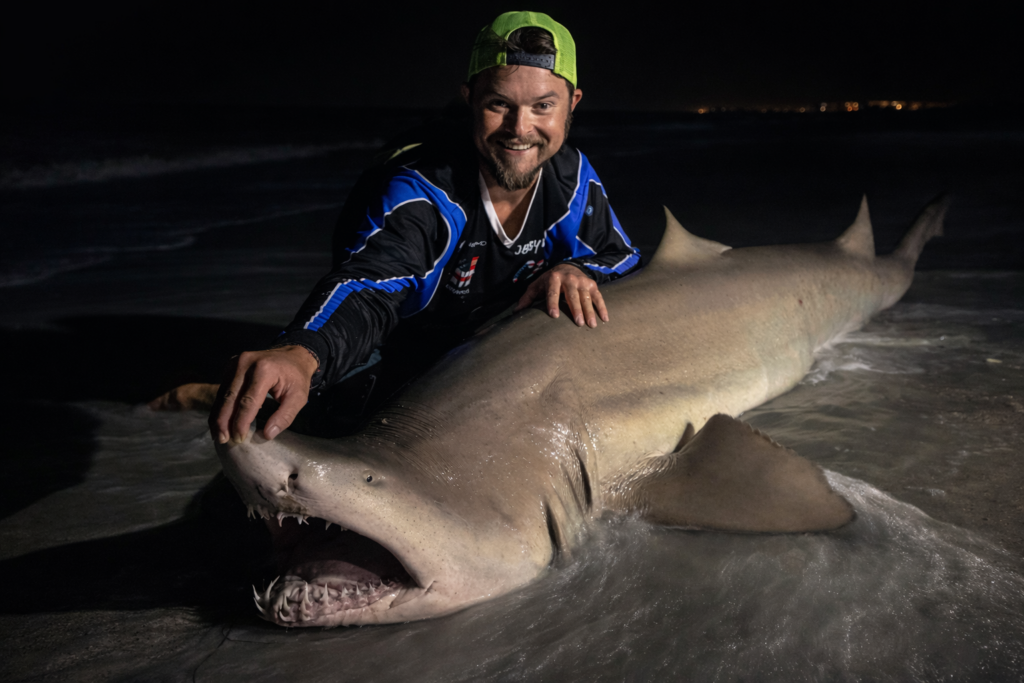
“Snap a quick picture, send it on its way.” — Bobby Win
In the salt, that question often points to sharks.
What makes Bobby’s story especially valuable is that he did not begin with the luxury of a boat. He began with constraints. That is how many people approach shark fishing today: from the beach, without offshore access, watching videos of land-based anglers and realizing that the ocean, while never tame, is not inaccessible. It simply requires a different kind of planning.
He described watching those videos and thinking, in essence: I do not need a boat if I can figure out how to place the bait where the fish actually are. The moment you say that, you step into the real world of land-based shark fishing—where logistics becomes part of the sport, where safety becomes a non-negotiable part of competence, and where the “cool” version of the story is never as important as the correct version.
That ladder matters because it prevents the worst mistake a beginner can make: jumping straight to the most complicated form of the sport without earning the judgment that keeps people safe and keeps fish released with minimal harm.
Two schools from the beach: casting and deployment
Bobby framed land-based shark fishing in a way I appreciate because it is both simple and true: there is casting, and there is deployment.
Casting-based shark fishing is a natural bridge for surf anglers and for freshwater anglers with heavy casting experience. You can use a robust setup, use baits that can be thrown, and fish closer in. You learn how the water moves, how currents shape your presentation, how sharks behave in the nearshore zone, and how to manage a bite and a release without needing a second layer of equipment to get bait hundreds of yards offshore.
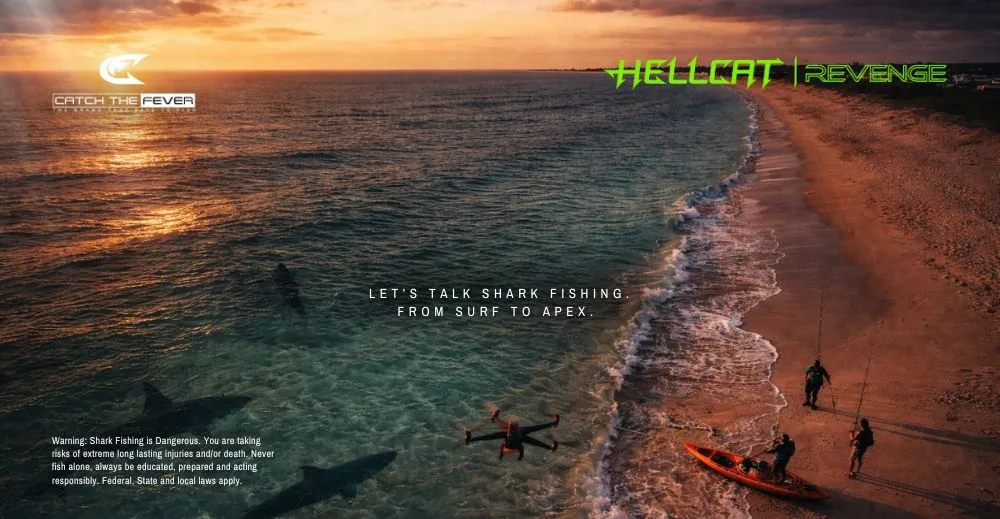
Deployment-based shark fishing is the other world. Once your baits become too large to cast, or once your strategic goal is to place them far beyond the surf zone, you need a mechanism to carry those baits out. Bobby described the three most common approaches he sees: kayaks, RC boats, and drones. Each comes with its own limitations, risk profile, and complexity, and we will treat them with the seriousness they deserve.
Even the language matters. “Deployment” sounds tidy, almost corporate, but what it really means is that you are running an operation at the edge of the ocean: managing heavy baits, heavy line, heavy drag systems, and a living animal on the other end that can turn that entire system into chaos if you are not prepared.
One reason I am writing this series is to help people understand that difference before they spend money and before they put themselves in a situation they are not trained to manage.
The beach is not a private arena. It is a shared environment with families, swimmers, and people who may never consent to being part of your story. A disciplined angler thinks about that before the first bait hits the water, not afterward.
The public-beach reality and the importance of social maturity
One of the most quietly important things Bobby said was about timing and discretion.
He talked about arriving later, when the beach is clearing, and about being mindful of what your activity looks like to the public. A large bait on a large hook sends a message even to people who know nothing about fishing. The wrong reaction is to dismiss public concern as ignorance. The correct reaction is to understand that perception drives politics, and politics drives regulation.
If you care about shark fishing, you should care about keeping it legitimate in the public mind. That means behavior that is calm, controlled, and safety-forward. It means not turning a public beach into a spectacle. It means reducing unnecessary conflict. It also means being willing to walk away from a location if it is crowded or if conditions make safe handling and safe release improbable.
This is not about surrendering the sport to fear. It is about treating the sport as a privilege that survives only when the culture around it behaves as if it deserves to survive.
And that cultural maturity is now inseparable from media maturity. Shark fishing draws attention. It always has, but modern platforms amplify it. The same content that can inspire people can also encourage the wrong kind of imitation. We will address that directly in this series: how to film responsibly, how to avoid delaying release for footage, how to choose narratives that honor the fish rather than humiliating it, and how to make “doing it right” the most respected version of the story.
Risk, responsibility, and why Bobby’s caution matters
Bobby also said something that I consider essential: going land-based shark fishing alone, especially with big gear and serious baits, is not something he recommends.
He did not say it with fear. He said it with care.
That distinction matters. A responsible angler is not a pessimist. He is a realist who wants others to experience the sport without paying the price of unnecessary mistakes. In the shark world, those mistakes can involve injuries, accidents, or compromised releases that harm fish and undermine the ethics of the sport. This is where my respect for Bobby is not theoretical. I respect the way he thinks and shares his knowledge. He is not trying to make shark fishing sound like a fantasy. He is describing it as a discipline that demands people, planning, tools, and a calm sense of procedure.
That is why he emphasized roles. Someone has to manage the rod. Someone has to manage the landing and the surf position. Someone has to have the tools ready. Someone has to handle the camera only if it can be done without delaying release. You may think these factor are unimportant – wrong. Those are the difference between competence and chaos.
In future articles, we will build those role systems into practical protocols: a pre-trip checklist, a landing choreography, a release procedure, and a set of ethical “stop points” where you decide to cut, release, and end the interaction rather than forcing a moment that is dangerous or prolonged.